
On thin ice: How the Yupik people survive in the warming Arctic
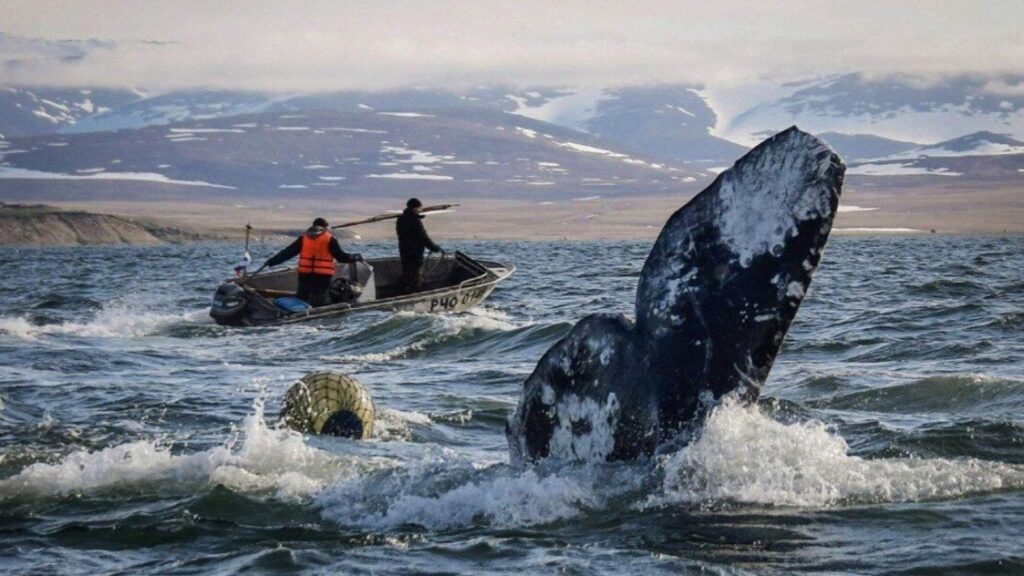
In the remote northeastern corner of Russia lies Chukotka, a vast, windswept region bordered by the Bering Sea and the Arctic Ocean. Here, in one of the harshest climates on Earth, the Siberian Inuit have lived for generations.
They call themselves Yupik. Yupʼik (the plural of Yupiit) literally means “real people”. Today, only 1,500 Yupik live in Chukotka. They are doing everything they can to preserve their unique culture and lifestyle in the face of challenges posed by climate change.
Disappearing Ice
One of the most drastic manifestations of climate change is the rapid shrinking of the Arctic sea ice cover. According to international climate agencies, including the IPCC and the World Meteorological Organization, the Arctic is warming several times faster than the global average. The changes in the Arctic sea ice are manifested in several important characteristics, including specific temporal and spatial patterns; timings of ice onset and removal; the duration of the melt season; the thinning of first-year sea ice; and decreases in the multi-year ice area.
Climate change is having a major impact on the lives of Indigenous Peoples of the Arctic, especially its influence on food supply and everyday diet. From ancient times to the present day, sea mammals have been the main source of food for the Yupik people. However, hunting has become much more difficult.
“We hunt seals on the pack ice during winter. But for the last 10 years, the ice hasn’t formed on the coast,” says Valery Kavaugye, a sea hunter a small village in Chukotka called Sireniki. “So we have to go on boats for 2 km to the sea to get the animals. It’s very dangerous due to the grease ice and large waves, and it’s better to stay home.”
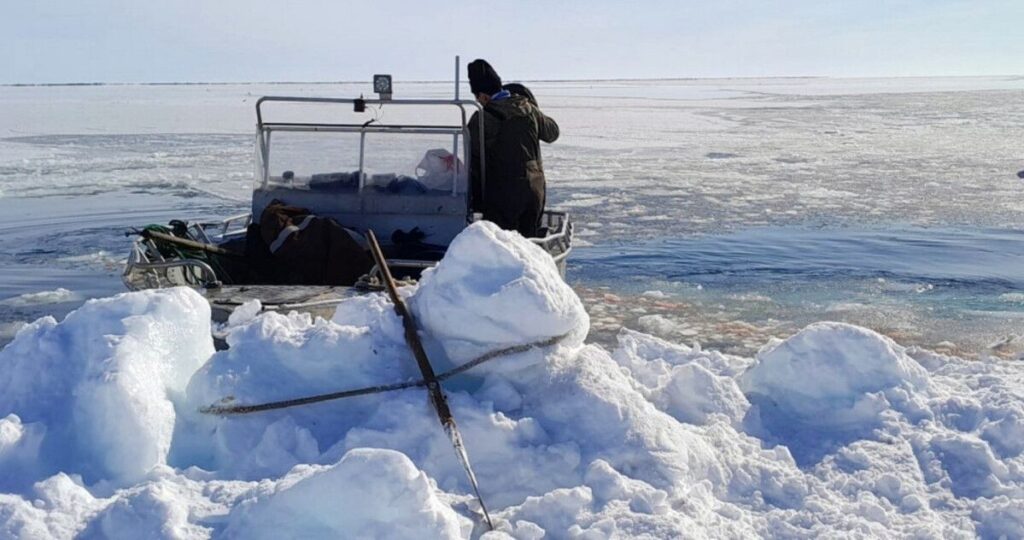
In other Yupik villages, residents are also noticing changes wrought by global warming. Instead of strong ice in winter, only drifting ice has been visible in the bay for more than a decade. Storms have become more frequent and frosts stronger. In contrast, summers are warmer and longer now.
“If the problem is not solved, we will lose our identity. We will not be able to apply our traditional skills. As a result, many Yupik terms for hunting and environment are disappearing,” explained Maria Panaugye, a community activist of in the small town of Provideniya. “For example, you no longer hear the words ‘pack ice’ in the Yupik language anymore. These words are forgotten.”
Subsistence Whaling
Sea hunters on the Chukotka coast catch whales from May to the end of October. For residents of remote northern villages, whaling is a way to survive and feed their families. The industry is regulated by the International Whaling Commission (IWC), and is recognized as a subsistence practice.
Nowadays the IWC gives the indigenous community quotas for catching fish. In 2025, hunters of Chukotka were given a quota of 132 grey whales and two bowhead whales.
Grey whales are the more common of the two, so the catching of a bowhead whale is a cause for celebration. This mammal is much bigger and its meat could feed a village and be used to make stocks for the winter. Catching them requires coordination, experience, and luck.
A similar situation exists in the village of Novoye Chaplino.
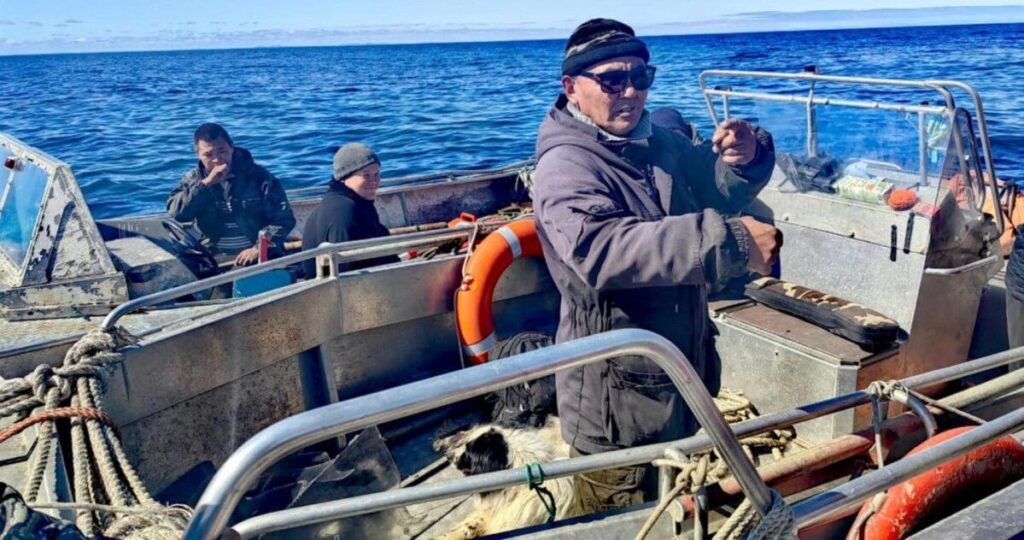
“Several years ago, there were a lot of bowhead whales in the bay in November and December,” says Igor Makotrik, chairman of Novoye Chaplino’s hunting community. “But we have not seen them for over 10 years. We have to limit ourselves by hunting grey whales only. Also, there are a lot less seals, as well as migratory birds.”
As a result, quotas and regulations remain fixed, but whale migrations no longer follow predictable routes. Hunters now face growing uncertainty, and if nothing changes, the seasonal rhythm of village life will come under threat.
For the last five years, the Indigenous An’yapik boatyard has been operating in Novoye Chaplino. It was built with a grant that its owner, Yuri Selyakin, received from the World Wildlife Fund through its Climate Adaptation Program.
“In the Yupik language, ‘an’yapik’ means a ‘real boat’ that was used for hunting whales and walruses. It was large and could carry up to 30 people,” Selyakin says. “I use only traditional methods to make an an’yapik boat. The frame was made of driftwood and whale ribs, fastened with whalebone and covered with walrus skin. I built my first boat when I was in high school.”
These boats are rarely used nowadays, if at all, with sea hunters preferring motorboats. However, coastal villagers can see an’yapiks in summer during the Beringia Anniversary Sea Hunters Regatta, when crews compete with each other.
The Ancestors’ Guide
In the Soviet era, state-run industrial whaling operations took over the task of hunting whales. As a result, the Yupik almost forgot how to hunt using traditional methods because for many years they only engaged in cutting up carcasses that were brought by Soviet flotillas.
When the Soviet Union’s collapsed, the crisis began in Chukotka. Supply chains broke down, wages went unpaid, and severe shortages swept across the region. Communities faced acute food insecurity, worsened by Arctic isolation and failing transport routes. In order to survive, Yupik had to revive traditional fishing and hunting practices.
Svetlana Tagyok, a Yupik elder and knowledge keeper, experienced all the difficulties of that time. As a journalist at Chukotka’s Indigenous radio station, she collected knowledge from the elders and hunters for many years. Later this knowledge proved vital to her community.
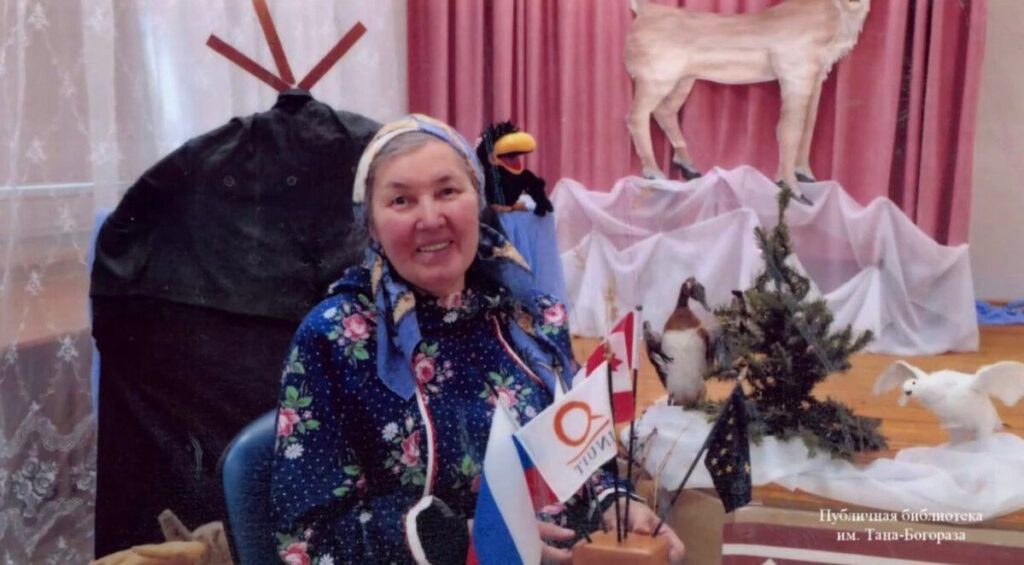
“To survive, we had to remember our knowledge. But it was very difficult — many elders had passed away, and we had to piece everything together bit by bit,” Tagyok recalls. “My brother and uncle were sea hunters themselves. Their stories helped me see what was being lost. ‘When you sit in the an’yapik [a traditional Yupik skin boat],’ they told me, ‘you must forget Russian speech. Hunting equipment can only be named in Yupik. Any mistake could be tragic.’”
As a vivid example, Tagyok shared a story about sea hunters who were drifting on an ice floe for a few days. All the men suffered from frostbite except one; he didn’t get sick because he wore traditional clothes.
The materials Tagyok gathered over many years became the basis for The Handbook for Young Sea Mammal Hunters. In the guide, the author shares recommendations on hunting in different weather conditions, surviving in a storm and in the tundra. The book also includes a description of hunting equipment, along with the rules list for constructing boats and sewing ethnic clothes.
Young Sea Hunters
In Chukotka, basic sea hunting skills are usually taught from childhood. Hunters in local communities teach children to knit knots and make tips for harpoons. By the age of 16, boys already go to sea, where they begin learning to harpoon whales.
But now the tradition of teaching sea-hunting skills is under threat. Many young people are leaving their home villages after graduation to study or work in towns. Climate change makes the problem worse by affecting ice safety and animal movements. Elders feared that place‑based knowledge were at risk of being lost.
As a response to these challenges, the community decided to bring elements of sea hunting into schools. In 2019, respected elder Evgeny Siv-Siv initiated the School of Young Sea Hunters. He offered to include basic hunting skills in the curriculum. Siv-Siv passed away in 2021, but the program he started continues to grow.
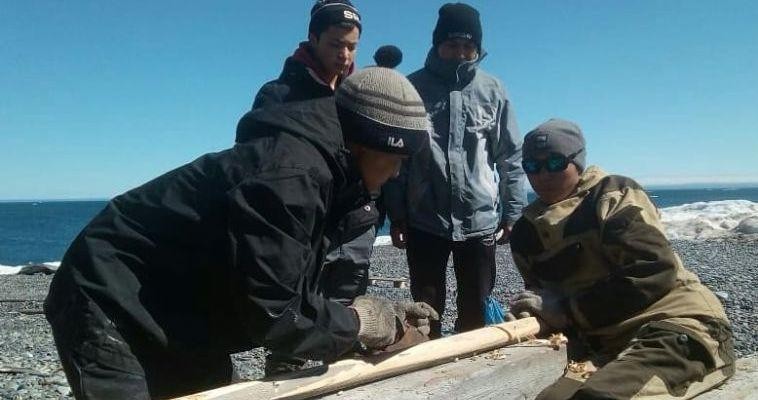
At the School of Young Sea Hunters, children begin to learn about the hunt at summer workshops from the age of five. Mentors teach them about marine mammals, and they also learn to sing traditional songs and rituals that connect the hunt to the spirit of the sea. Older kids try practical skills such as net-weaving, carving, and hide work.
Experienced hunters teach boys to use tools passed down from their ancestors: in’nypya, a long pole with a hooked end and metal tip for testing ice; ulu, the curved Yupik knives used for skinning and food preparation; and pyh‑pyh, a sealskin buoy. Teenagers move on to boat work, harpooning techniques, and the maintenance that keeps crews safe.
Five years after it started, the seasonal school training has already shown results. Several graduates from the School of Young Sea Hunters are now working in sea‑hunting communities. Many teenagers also say they plan to stay in the village after graduation and become sea hunters, carrying the tradition forward.
Anna Rogojine is a journalist with more than a decade of experience in news reporting, investigative journalism, and Indigenous-focused storytelling. She lived and worked in Chukotka, one of the most remote regions of the Russian Arctic, reporting on Indigenous affairs and traveling to remote communities to document traditional livelihoods.


