
Greenland’s oil dispute is testing Arctic sovereignty
In July, an excavator and 15 shipping containers arrived at the Nerlerit Inaat port in eastern Greenland. According to Danwatch, the shipment is the first wave of equipment for Greenland Energy’s planned exploration campaign in Jameson Land. The company has said another 300 containers and a drilling rig are scheduled to arrive in September. Greenland’s Ministry of Business and Mineral Resources, however, says the project does not yet have the approvals required to begin drilling.
What began as a permitting dispute is evolving into an early test of how the U.S. is pursuing its expanding strategic interests in Greenland, placing the project at the complicated intersection of energy policy, Arctic strategy, and Greenlandic sovereignty.
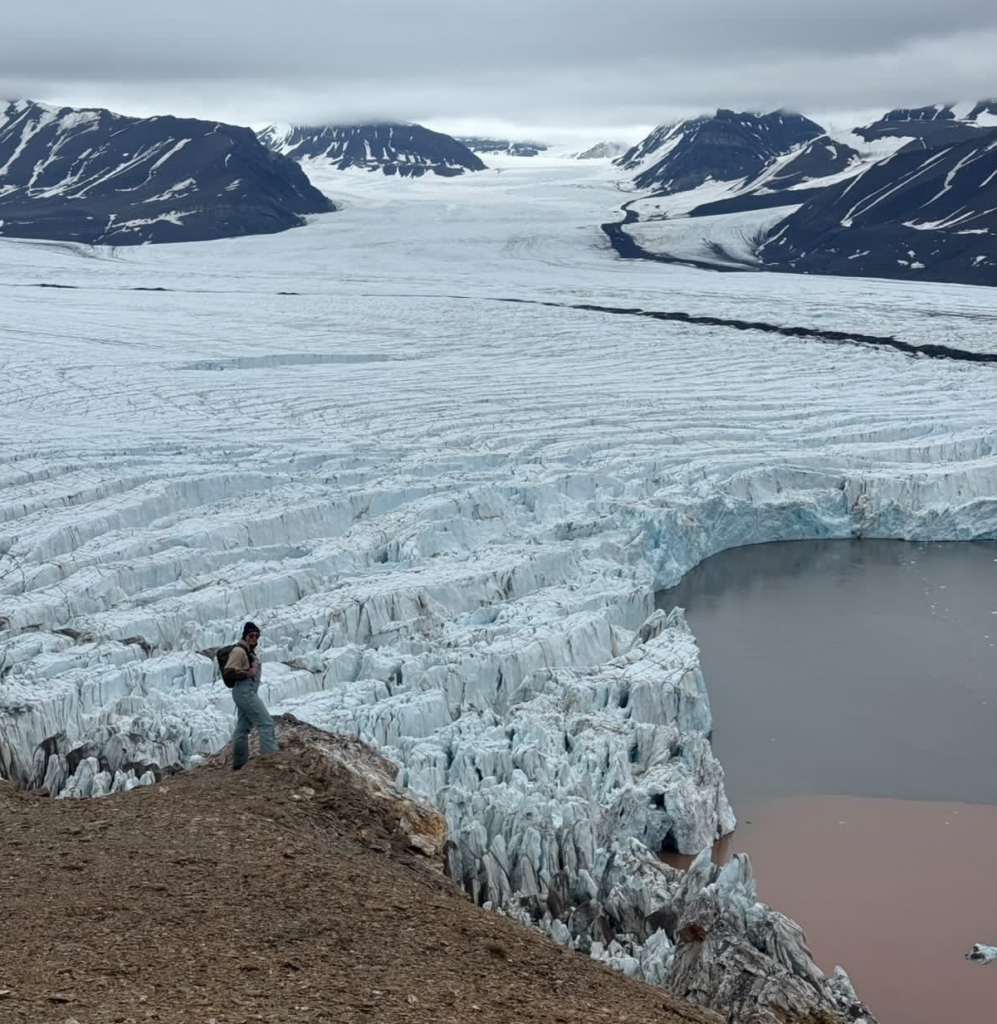
Greenland Energy’s Exploration Campaign
In 2021, Greenland announced that it would stop issuing new oil and gas exploration licenses, but said that existing licenses would remain in force under their original terms. One of those licenses is now held by Greenland Energy, a U.S.-listed exploration company pursuing two exploratory wells in Jameson Land.
This spring, Greenland Energy raised approximately $70 million in a public offering. The company has since contracted an Arctic drilling rig, secured integrated well planning and logistics services from Halliburton, and begun mobilizing equipment for its two-well exploration campaign. The company estimates that its license area contains as much as 13 billion barrels of gross unrisked prospective resources. The same filings make clear that these are not reserves, and that no modern exploration well has yet demonstrated that Jameson Land contains commercially recoverable oil.
Greenland Energy’s drilling schedule targets its first exploration wells for the fourth quaerter of 2026 through the first quarter of 2027. Greenland’s Ministry of Business and Mineral Resources, however, claims the license holder did not have approvals for the July equipment mobilization, putting its Q3 activities at odds with the local approvals process. It’s worth noting that large energy projects rarely progress in a straight line. Financing, procurement, logistics and permitting often proceed on separate timelines. Drilling contracts can be negotiated before exploratory campaigns begin, and it’s not uncommon for equipment to be ordered before regulatory reviews conclude.
The challenge is that in Greenland, decisions that would ordinarily be viewed as technical regulatory questions are now being interpreted through a much broader strategic lens, given the Trump Administration’s declaration of interest and prospective ownership of the Danish autonomous territory. That political posture places additional pressure on institutions designed to evaluate exploration projects on legal, environmental, and commercial grounds.
Greenland’s Energy Resources and Global Energy Geopolitics
Louisiana Governor and Special Envoy to Greenland Jeff Landry recently stated that Greenland “could be exporting 2 million barrels of oil a day. Think about what kind of pressure that would relieve in the Strait of Hormuz.” At that level of production, Greenland would rank among the world’s larger oil exporters, producing the equivalent of roughly 15 percent of current U.S. crude oil and about 2 percent of global supply. No public development plan supports production at that scale, however.
Landry’s comments have come alongside the administration’s broader posture toward Greenland. President Trump has repeatedly raised the prospect of U.S. control of the island, while Landry’s appointment as special envoy was itself met with opposition from Greenland’s government, due to American annexation threats. Greenland Energy executives themselves have indirect ties to President Trump and the administration, including Carol Craig, whose defense firm is involved in the planned Golden Dome system (itself argued as part of the rationale for U.S. control of Greenland), and Kenneth Griffen, who holds a 9.3% stake in the company and donated $1 million dollars to the 2025 inaugural committee.
Against that backdrop, an American envoy publicly presenting Greenland’s prospective oil resources as a solution to U.S. energy security carries significance beyond ordinary commercial advocacy.
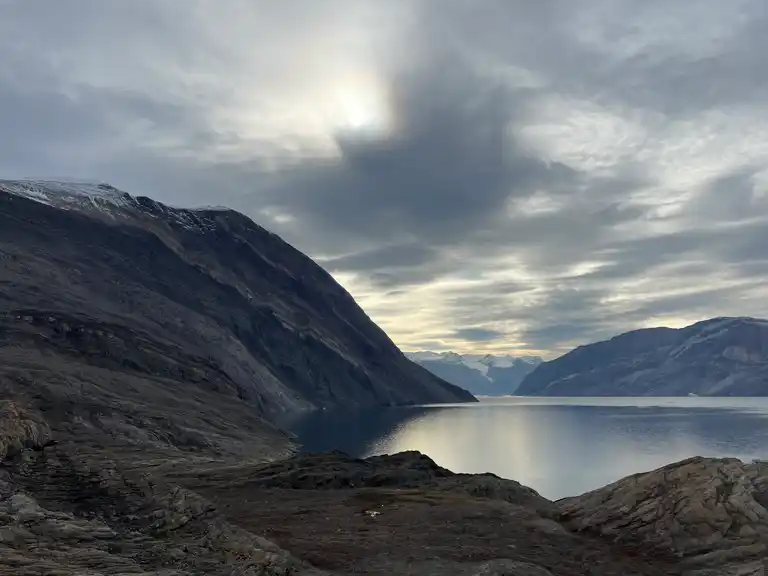
The administration is publicly treating Greenland’s prospective petroleum resources as an American strategic asset even though Greenland has not authorized their development, turning ordinary commercial momentum into political pressure on Greenland’s regulatory process. That approach may advance near-term U.S. energy interests, but undermines the institutional sovereignty on which a durable U.S.-Greenland relationship depends.
Resource Geopolitics in the High North
The Greenland case illustrates a broader shift in Arctic competition. Commercial activity, infrastructure, and regulatory institutions are increasingly becoming arenas of strategic competition alongside more traditional military and diplomatic tools.
Russia, for instance, has expanded its military posture across the Arctic while strengthening its control over the Northern Sea Route (which was available for energy shipping to Asia earlier this season due to faster melting ice). And Russia’s cooperation with China has grown since the invasion of Ukraine to include energy projects, shipping, and coast guard exercises.
While Putin stated Greenland’s ownership was of no concern to Russia, Trump’s “Greenland ownership” rhetoric has deepened the tension between the U.S. and its European allies, a chasm which Putin can capitalize on.
China, meanwhile, declared itself a “near-Arctic state” in 2018 and has pursued a Polar Silk Road linking resource development, infrastructure, and emerging northern shipping routes. Beijing’s direct economic footprint in Greenland remains limited, as the Minister of Business noted a preference for Western partnerships, but Chinese companies have previously sought stakes in Greenlandic mining projects and bids for strategically sensitive infrastructure. The Kvanefjeld project is one example: Chinese rare earth company, Shenghe Resources, is the second-largest shareholder in the Australian company behind the project, an investment some in Washington have seen as a “backdoor for Chinese encroachment in the Arctic.”
Greenland sits inside this competition because geography and resources overlap. Its location anchors missile warning and surveillance systems across the North Atlantic, while its deposits of rare earths (ranked 8th in the world for reserves) and other critical minerals have attracted attention as the U.S. and its allies seek alternatives to Chinese-dominated supply chains.
Yet Greenland’s experience with critical minerals also demonstrates the distance between geological potential and strategic supply. Despite substantial resource deposits, commercial development has been limited by infrastructure constraints, high costs, and Greenland’s own regulatory decisions. The Kvanefjeld project, for instance, has seen its own exploration and development phases halted, as Greenlandic authorities denied an extension of its exploration license under the current legislative framework.
Kvanefjeld highlights the fact that Greenlandic regulatory decisions have consequences for foreign capital, and that Greenlandic sovereignty is intertwined with resource management. Greenland’s own Arctic Strategy report on foreign, security, and defense policy is aptly titled “Nothing about us without us.”
There is no evidence that Greenland Energy is acting at Washington’s directive. Nor is such coordination necessary for a commercial project to acquire strategic significance. American officials citing a private company’s prospective resources as evidence of Greenland’s importance to U.S. energy security has already blurred the line between commercial advocacy and national security.
Commercial momentum may appear advantageous for Washington: a U.S.-linked project could expand Western access to Arctic resources while limiting opportunities for competitors. For Greenland, however, the same momentum may narrow the political space in which regulators operate. Its decision to delay or reject development risks being geopolitically interpreted as hindering U.S. strategic interests. Meanwhile, Russian and Chinese activity gives Washington good reason to favor Western investment.
Sovereignty as Strategy
Congress, concurrently, has been redefining U.S. Arctic policy.
In June, Sens. Lisa Murkowski and Jeanne Shaheen introduced a bipartisan resolution “reaffirming congressional engagement with Arctic allies”, including the importance of Indigenous peoples’ inclusion in Arctic governance and decision-making. The resolution highlights Arctic security, infrastructure, telecommunications, scientific research, Indigenous engagement, and cooperation with allies as core U.S. priorities.
Following the resolution, the Senate Foreign Relations Committee advanced S.4708, the Arctic Security and Diplomacy Act.
The Trump administration has good reason to support Western investment in Greenland. But its approach could work against that goal. Tying individual resource projects to U.S. strategic interests gives Greenlanders another reason to view resource development through the lens of American pressure, leveraging its own institutions to push against American investment.
Petroleum development is only one component of a much larger regional agenda, in this light. American interests in Greenland long predate the current exploration campaign.
Greenland’s geography is central to Arctic defense, North Atlantic security, and telecommunications infrastructure. Pituffik Space Base has been in use since 1943, under a Danish-American defense agreement, today supporting U.S. missile warning and space operations.
Defense, space operations, telecommunications, critical minerals, and scientific research all overlap in Greenland. Those interests do not depend on whether Jameson Land ultimately becomes a producing oil field, yet much of the public discussion has become dominated by the progress of this single exploration project.
Congress should reinforce Greenlandic self-determination and regulatory sovereignty as explicit components of U.S. Arctic policy. That may run counter to the administration’s current approach, but further alienating Greenland and European allies carries its own strategic cost: a more divided West leaves greater room for Russia to consolidate the Northern Sea Route as an energy corridor and for China to expand its Arctic economic presence.

DeLaine Mayer is a professor at New York University’s Center for Global Affairs. She holds master’s degrees in Global Affairs and Energy/Environmental Policy from New York University and Space Resources from the Colorado School of Mines. Her work explores the intersections of emerging technology, international relations, climate, geopolitics, and remote frontiers.


