
Iceland’s no to the EU cannot vote away Trump’s map
Nine days after Icelanders voted against resuming EU accession talks, Donald Trump posted a map showing Iceland, Greenland, Canada and many other countries under the US flag. Former Prime Minister Þorsteinn Pálsson argues that the referendum settled nothing and that Iceland should now join Canada in seeking closer ties with the EU.
The US administration has published a map on which Iceland is symbolically defined as part of its territory, in the same way as the individual states of the United States. Canada and Greenland are also on it, along with the countries of Central America and the Caribbean.
The attitude towards Iceland displayed there has been in the air for some time and was obviously planned long ago. It therefore came as no surprise. On the other hand, it is difficult to avoid viewing this event as marking a watershed in relations between the two nations.
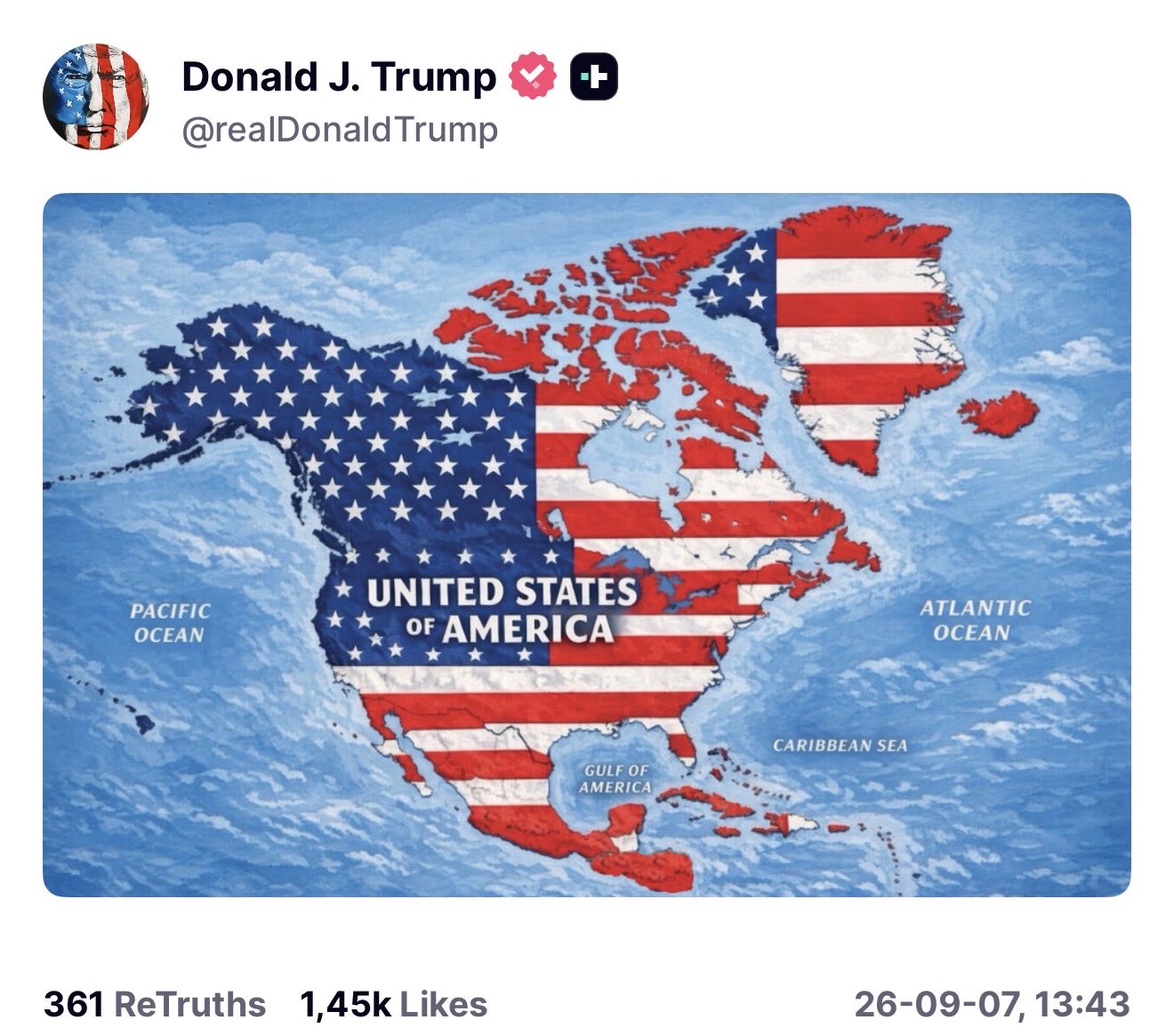
Apart from congratulations from the MAGA movement, this was the US administration’s first formal message to Iceland after the referendum [of 29 August, on resuming EU accession talks]. It came without delay once the vote was over.
The big question is: what lies in store as more time passes? That is something the government and the National Security Council [which the prime minister chairs] need to assess and discuss with the nation. It would be irresponsible to take it for granted that the matter is over. It is more likely that this was a first step.
A new symbol of what the partnership amounts to
The sculpture Samstarf (“Partnership”) by Pétur Bjarnason stands opposite Höfði [the Reykjavík house where Ronald Reagan and Mikhail Gorbachev held their 1986 summit]. It was a gift to Icelanders from Charles Cobb, then the US ambassador, and his wife, Sue Cobb, to mark 50 years of diplomatic relations between Iceland and the United States. The sculpture symbolically depicts a partnership between two states of equal standing.
The US administration has now presented the Icelandic nation and the rest of the world with a new symbol, which reflects its assessment of what the partnership amounts to today. The image of relations between two nations can hardly be changed more decisively.
The foreign minister [Þorgerður Katrín Gunnarsdóttir] immediately summoned the US ambassador [Billy Long] and conveyed the Icelandic government’s view that this new symbol was highly inappropriate. That was right, but at the same time it was a restrained remark.
The prime minister [Kristrún Frostadóttir] then described the new symbol as an insult to an independent and sovereign nation.

Complete trust in someone who is not to be taken seriously
Spokespeople for the Independence Party [Iceland’s main centre-right party, now in opposition], on the other hand, feel that the government and the many ordinary citizens who will not accept conduct of this kind are making a mountain out of a molehill. One of them put it this way: the reactions reflected “the final meltdown over having lost the referendum”.
But the paradox appears in the fact that, at the same time, they say the President of the United States is unpredictable and not to be taken seriously – except sometimes – and that the Icelandic government should therefore keep a low profile when events of this kind occur.
And then the nation is urged to trust implicitly what was put on paper in the middle of the last century in the Defence Agreement [the 1951 agreement under which the United States undertakes to defend Iceland, which has no armed forces of its own], and to reject any kind of cooperation with other nations on trade and on defence against modern dangers.
In other words: we are to have full and unlimited trust in someone who is not to be taken seriously.
The reactions to the US administration’s decision to publish this map with Iceland in the colours of the US flag indicate unambiguously that those who won the referendum do not consider their victory sufficient, precisely because this symbol of a changed world did not evaporate with the result.
They are therefore still campaigning, fighting for the nation to acknowledge that it was in reality approving the Independence Party’s particular stance towards the United States – which was certainly not asked about on the ballot paper.
It is as if they consider it contrary to the outcome of the referendum for the Icelandic government to make the polite remark to the US administration that its conduct is inappropriate and offensive.
Formal sovereignty and political independence
In this context, it is important to distinguish between formal sovereignty and political independence. In the Soviet era, the states east of the Iron Curtain had formal sovereignty. They were, for example, members of the United Nations.
These states, however, lost their political independence. They were what are called satellite states. But Iceland became an active participant in Western economic and defence cooperation because of shared values of freedom and respect for the sovereignty and self-determination of states.
On Silfrið [a political discussion programme on the public broadcaster RÚV] on Monday evening [7 September], an Independence Party spokesperson said that it would have been a provocation to the United States to approve full membership of the European Union. All our other allies in Europe have taken such decisions without that being regarded as a provocation to the United States. It may be said that, until now, it is rather the opposite that has underpinned those decisions.
The US administration’s new symbol need not express plans to abolish Iceland’s formal sovereignty, even though that is the policy towards our neighbours, Canada and Greenland. On the other hand, no one can be in any doubt that the new symbol shows a country which, in the administration’s eyes, has no political independence.
It is this reality that confronts Icelanders. It was not voted away.
It is true that a majority of the nation rejected the simplest and quickest way of meeting the new circumstances. But they must be met regardless.
We have to face the fact that, in foreign affairs, the easiest way of meeting three kinds of new threats has been closed – threats that could not be voted away and are therefore still present.
First, it is obvious that the change from international rules of the game on free trade to a global tariff war waged with trade barriers makes it too risky for Iceland to stand outside a customs union. [Iceland has access to the EU single market through the European Economic Area but is not part of the EU customs union.]
Second, we need deeper and more active cooperation with other nations because of hybrid threats, which the Defence Agreement does not cover and which NATO has partly transferred to the European Union.
Third, it would be the height of imprudence to assume that Iceland’s position in relation to the United States is fundamentally different from that of Canada, or of Denmark and Greenland within the Danish Realm.
This is a reality that no denial can change either. What, then, can be done?
The public has a right to know about all dealings with the United States
The government should immediately inform the nation of all the main points of substance in its own and the previous government’s dealings with the US administration since November 2024, when the current president was elected.
This is unavoidable if the nation is to be able to take a position on the country’s real situation.
The authorities may have more information on the US stance towards Iceland, beyond what the rest of us see and what has now come out publicly with the US administration’s new map of Iceland in American flag colours.
For example, it was reported at the time that the newly elected US president had spoken with the former prime minister [Bjarni Benediktsson] shortly before the latter left office. There have also been reports of formal meetings and informal conversations involving the prime minister and the foreign minister [with US officials].
Furthermore, the government needs to provide information on talks between the business community and unspecified American parties, with government representatives present as observers, which have been reported without any mention of their substance.
The Federation of Icelandic Industries has disclosed that it has held talks with US officials and leaders in American business. The federation bases its demand for linking energy supply with tariff agreements on those talks. [TK: what the proposal involves]
Without further explanation, that demand comes across as if sovereignty in energy matters is to be traded for tariff concessions. Those suspicions must be cleared off the table before going any further.
The question is: has anything come up in these dealings that touches on the question of Iceland’s sovereignty – such as independence in energy matters – or anything that could be linked to the publication of the new map?
In light of all this, it would be natural for the prime minister to call a meeting of the National Security Council to discuss this new situation.
The nation has a legitimate claim to see a complete picture of these dealings over almost two years, in order to judge whether a watershed has occurred in relations between two nations, or whether those who lost are merely having “the final meltdown”.
The Canadian government, for example, disclosed the fundamental issues on which its talks with the US administration ran aground – such as a demand that could be interpreted as a challenge to self-determination and sovereignty – even though confidentiality applied to various technical points.
Joining forces with Canada for closer cooperation with the European Union and other free-trade countries
The European Union is today the only forum for cooperation between nations on free world trade that can stand on an equal footing with China’s totalitarian regime and the United States in their war of trade barriers and sky-high tariffs, waged with complete disregard for the sovereignty of the countries they deal with.
Since the Davos conference earlier this year, Canada has been at the forefront of the idea that medium-sized and small states outside the European Union should aim for even stronger trade and economic cooperation with its member states, in order to defend free trade against the serious new threats it faces.
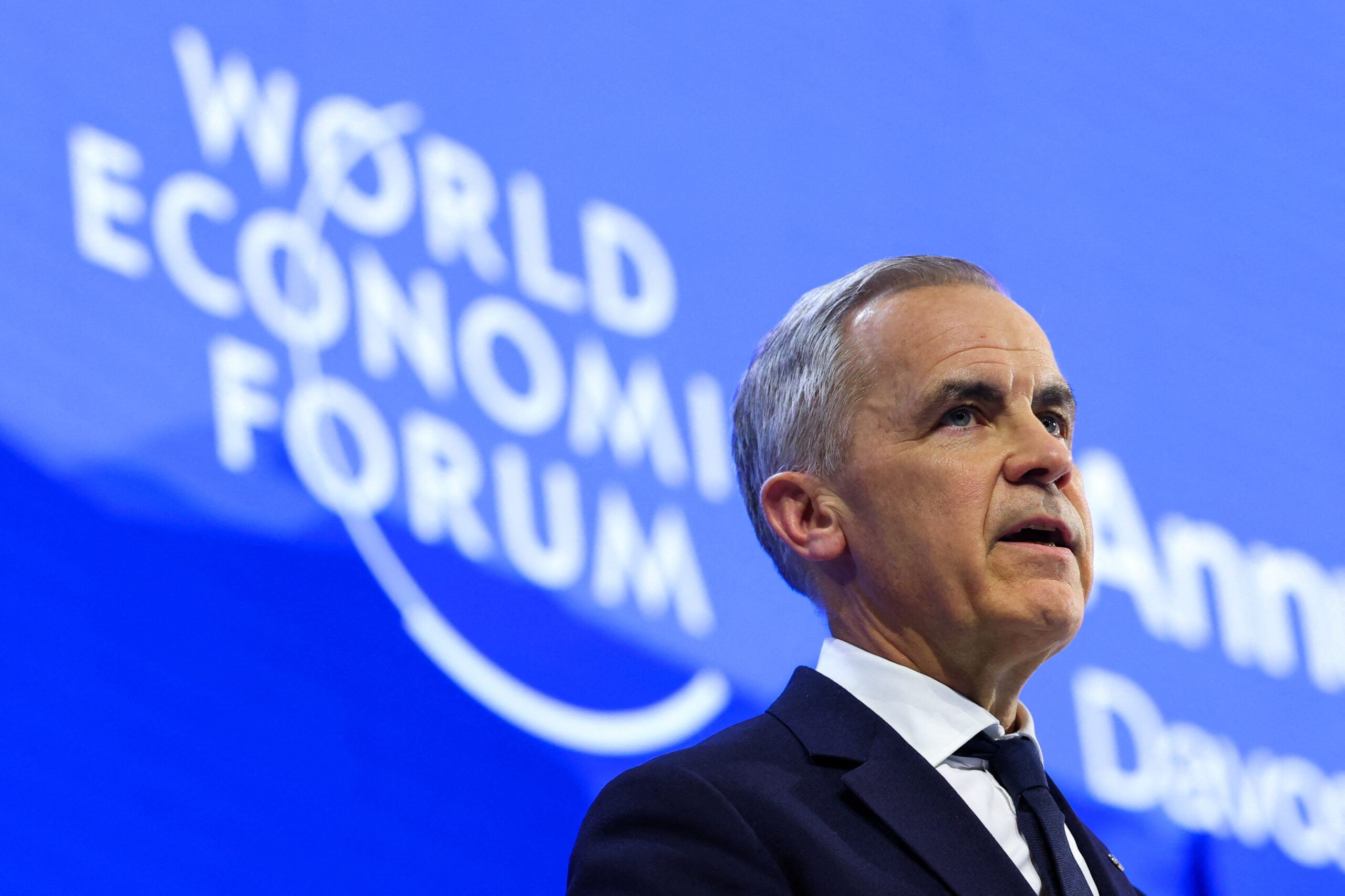
In that light, the foreign minister should respond quickly and ask that Iceland be able to become an active participant in that development and contribute to speeding it up, in Iceland’s interests.
This is a slower route than full membership of the European Union and not as secure for Iceland. But as matters stand, it is the only route. It is noteworthy that a former prime minister who represents the Progressive Party [a centrist party that was part of the previous government] on parliament’s Foreign Affairs Committee has mentioned that now is the right time to turn to Canada.
The government must therefore not delay in setting out its course on this. The wait-and-see policy of the Centre Party [a right-wing, Eurosceptic opposition party] and the Independence Party is completely irresponsible in the current circumstances. There is no way to infer, conversely, that the result of the referendum was support for that approach.
Þorsteinn Pálsson was prime minister of Iceland from 1987 to 1988 and led the Independence Party from 1983 to 1991. This article is translated and adapted from two of his columns published in Icelandic in DV’s Eyjan section on September 3 and September 10, 2026.


